
GTM Engineering vs RevOps
Where they overlap, where they differ, and how to decide which problem you are actually trying to solve.
Start with the important point
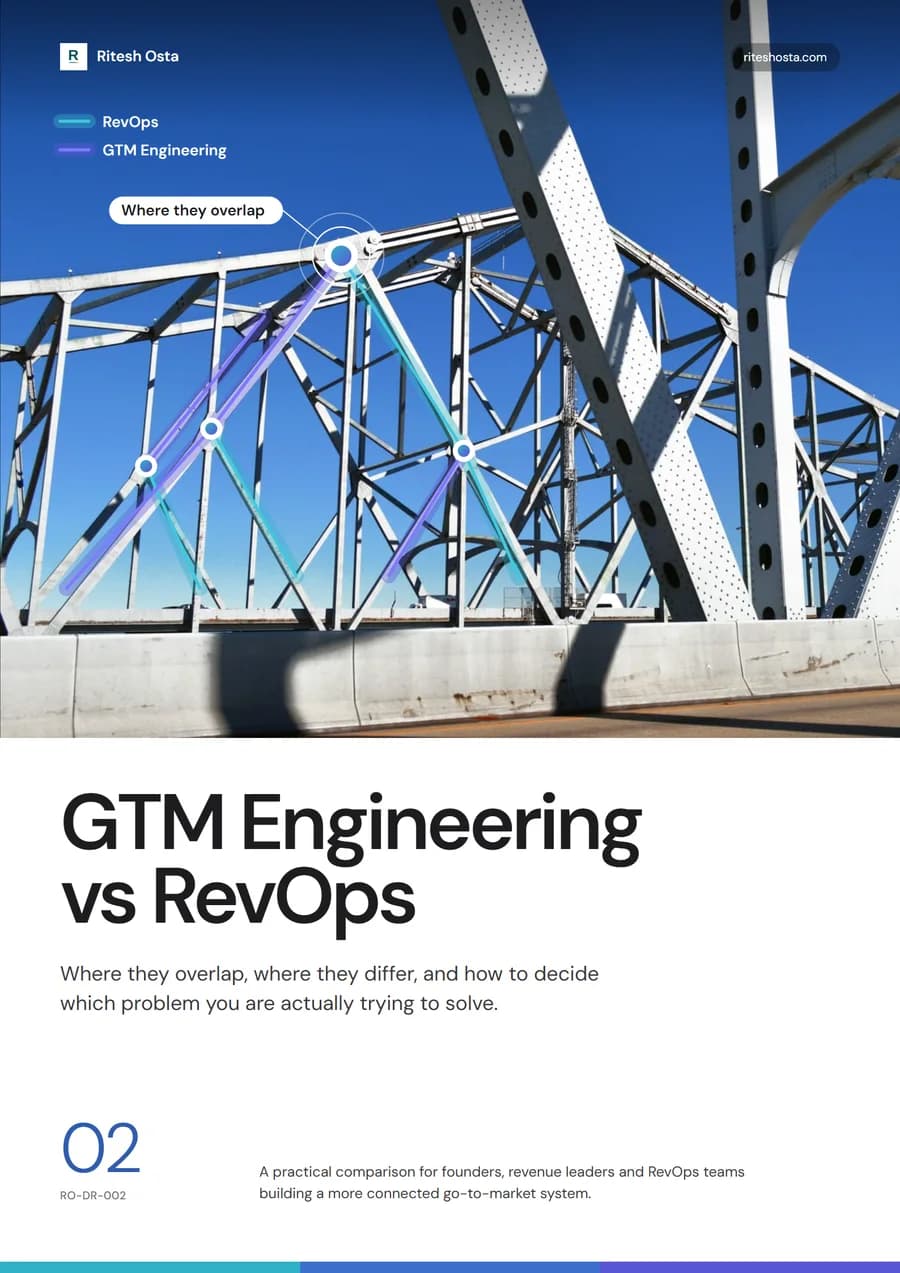
GTM Engineering and RevOps are not competing labels for the same thing, and they are not mutually exclusive.
- RevOps
- RevOps often focuses on how the revenue organization operates: data, process, lifecycle, systems, handoffs, reporting and alignment.
- GTM Engineering
- GTM Engineering focuses on how a go-to-market system is designed and implemented around signals, context, next actions, automation and learning.
In a mature organization, the two can work together.
A simple comparison
| Dimension | RevOps | GTM Engineering |
|---|---|---|
| Primary question | How should the revenue organization operate consistently? | How should the GTM system detect, contextualize, activate and learn? |
| Typical scope | Lifecycle, CRM, process, reporting, handoffs, forecasting, governance | Signals, enrichment, routing, activation, automation, AI-assisted workflows, measurement loops |
| System orientation | Operational consistency and alignment | Designed signal-to-action operating system |
| Common trigger | Broken process, CRM, reporting or team handoff | Missed demand/context, disconnected activation, static GTM motion |
| Typical output | Processes, lifecycle definitions, dashboards, CRM design, operating rules | Signal framework, context model, execution logic, workflows, campaign/system architecture, learning loop |
| Relationship | Can own/enable the operating environment | Can use RevOps infrastructure to execute the GTM design |
Where they overlap
- CRM state and lifecycle design.
- Routing and ownership.
- Data quality and enrichment.
- Automation and workflow governance.
- Measurement and reporting.
- Handoffs between marketing, sales and customer teams.
- Operational clarity around what should happen next.
The overlap is important because GTM Engineering should not build around a CRM model that RevOps cannot govern, and RevOps should not optimize workflows without understanding the GTM decision logic those workflows are meant to implement.
Where GTM Engineering goes further
- Defining which observable signals matter to a buying situation.
- Adding external and internal context before action.
- Connecting account-level events to message, channel and next-action decisions.
- Designing signal-triggered research, outreach, nurture, alerts or paid support.
- Using AI-assisted research and personalization under controlled business rules.
- Building feedback loops that change signal weight, routing, messaging or orchestration.
Where RevOps often goes deeper
- Revenue process governance.
- Lifecycle and pipeline definitions.
- Forecasting and reporting discipline.
- CRM ownership and data standards.
- Sales process consistency.
- Team operating cadences and accountability.
- System administration and revenue-data governance.
Which problem do you have?
| If this sounds familiar... | Likely problem pattern | Useful starting point |
|---|---|---|
| We have CRM data, but routing and lifecycle states are inconsistent. | RevOps / orchestration heavy | Signal Audit with UC-B context |
| We have good operations, but we still rely on static lists and late-stage leads. | GTM Engineering / signal activation heavy | Signal Audit with UC-A context |
| Marketing and sales use different account context and do not share next-action rules. | Mixed | Signal Audit / potential DFDP if complex |
| We keep adding tools but cannot explain what business decision each workflow should make. | Architecture / mixed | GTM Engineering diagnosis before more implementation |
| Our RevOps function is strong, but we want to operationalize new account signals. | GTM Engineering built on RevOps foundation | UC-A / Signal Audit |
| We want to improve the CRM but do not yet have clear lifecycle or ownership rules. | RevOps foundation | UC-B / operational diagnosis |
A useful mental model
Think of RevOps as the operating discipline that helps the revenue organization stay coherent.
Think of GTM Engineering as the design-and-build discipline that connects signal, context, action and learning inside that operating environment.
Neither discipline should be reduced to a software stack. The business rules come first.
Example: a new hiring signal
A company begins hiring multiple revenue-systems roles.
- GTM Engineering asks whether that event is relevant, what context is needed and what action is justified.
- RevOps ensures the account state, ownership, workflow, task and reporting logic can support the approved action.
The strongest implementation uses both disciplines rather than forcing the problem into one label.
When a DFDP may be useful
If the problem spans signals, CRM, workflows, multiple teams, unclear ownership and implementation decisions, a deeper strategic diagnosis may be more useful than treating it as a single RevOps or campaign project.
The DFDP is designed to clarify what should change, what should be built, what should remain out of scope, and what evidence is still missing.