
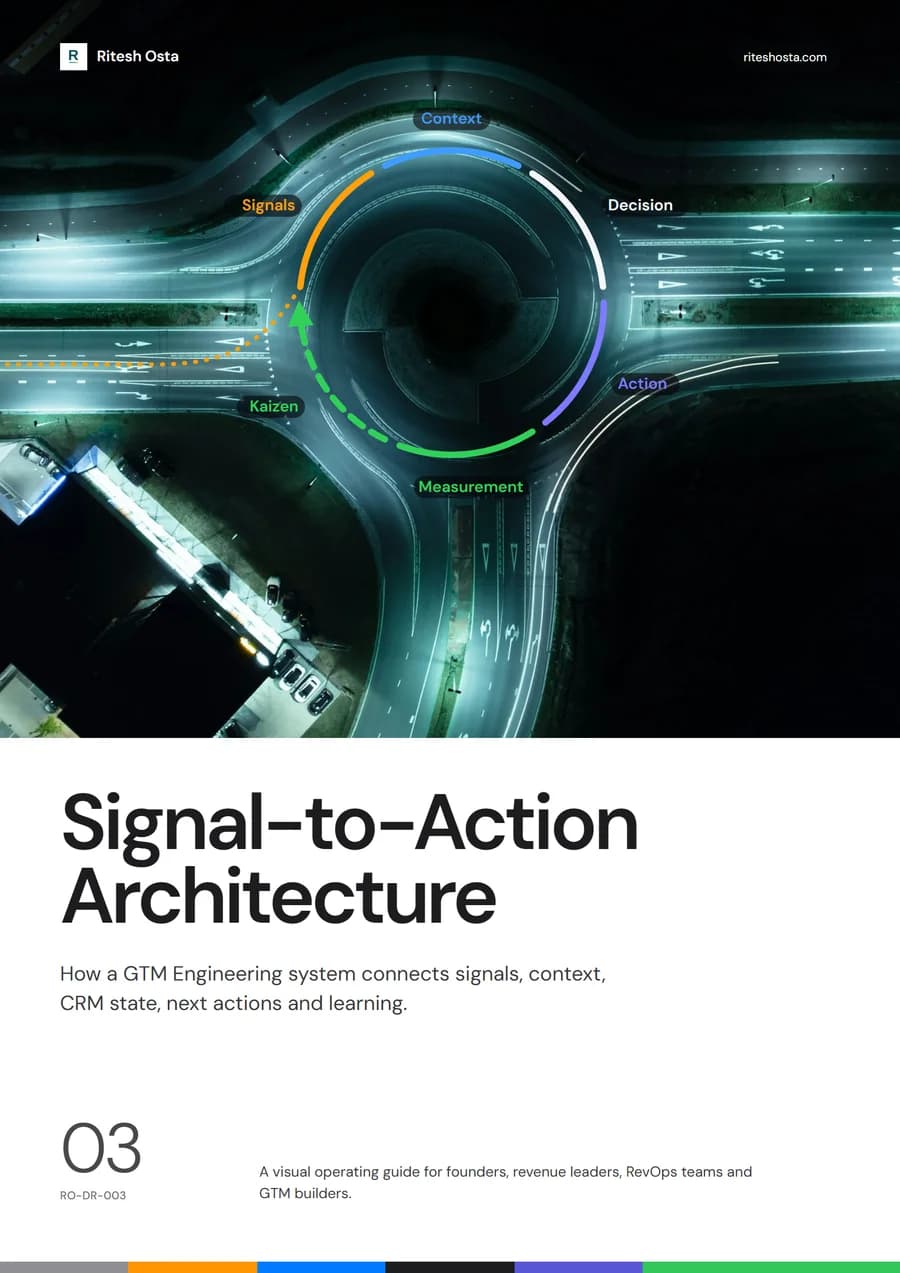
Signal-to-Action Architecture
How a GTM Engineering system connects signals, context, CRM state, next actions and learning.
The architecture in one sentence
A Signal-to-Action system detects relevant events, adds decision-changing context, routes the appropriate next action, captures meaningful outcomes and feeds the learning back into the system.
The seven layers
| Layer | Core question | Typical components |
|---|---|---|
| Buying Situation / Problem | What business situation are we trying to recognize or solve? | ICP, buying situation, GTM problem, operational state |
| Signals | What observable events could be relevant? | Hiring, technology, engagement, CRM events, company changes, first-party activity |
| Context / Augmentation | What else do we need to know before acting? | Fit, role, buying group, CRM history, relationship, technology, geography |
| Decision / Qualification | What does the combined evidence justify? | Fit logic, state, score, human review, not-ready/wrong-fit rules |
| Action / Reach | What should happen next? | Research, task, personalized outreach, nurture, alert, paid assist, no action |
| Measurement | What meaningful outcome occurred? | Diagnostic completion, fit-call booking, commercial progression, opportunity/revenue learning |
| Kaizen | What should change in the system? | Signal weight, context requirements, routing, messaging, automation, channel mix |
Start with the buying situation
A useful architecture starts with the problem, not the data source.
- What situation are we trying to detect or respond to?
- Which accounts are relevant?
- Which roles or buying groups matter?
- What outcome are we trying to enable?
- What would make the use case unsupported or out of scope?
Without a defined buying situation or operational problem, signal collection becomes a catalogue exercise.
Signal sources
Signals are observable events. The architecture should record the source, type, recency, reliability and the reason the event may matter.
| Signal category | Example | Control |
|---|---|---|
| Company change | Funding, expansion, acquisition, leadership change | Company change alone does not prove need. |
| Hiring | Relevant role or capability hiring pattern | Hiring is a hypothesis trigger, not a purchase event. |
| Technology | Adoption/removal/change of a relevant technology | Technology data may be incomplete or stale. |
| First-party engagement | Approved site/content/product interaction | Engagement does not automatically create a business CE. |
| CRM event | State change, prior conversation, hold reason, opportunity event | CRM meaning must remain consistent with approved lifecycle semantics. |
Context / augmentation
Augmentation combines external and internal context so the system can make a better decision.
- Company fit and segment.
- Relevant stakeholder / buying-group role.
- CRM lifecycle and qualification state.
- Existing owner, conversation or opportunity.
- Previous hold / not-ready reason.
- Technology or operational context.
- Consent, geography or eligibility constraints.
The goal is not maximum enrichment. The goal is enough context to change the decision.
Decision / qualification
The architecture needs explicit states rather than one generic score.
- Ready / relevant for next action.
- Needs more context.
- Temporary not ready.
- Wrong fit / unsupported use case.
- Potential DFDP fit requiring human review.
- Existing customer / Kaizen expansion context.
A score can support a decision, but it should not silently replace the business meaning of the state.
Action / reach
| Action type | When it can be appropriate |
|---|---|
| Research / enrichment | Useful event exists but context is incomplete. |
| Sales task / alert | Existing owner or relationship should decide next action. |
| Personalized outreach | Evidence and context are strong enough to justify a relevant conversation. |
| Nurture | Problem is relevant but readiness is not there yet. |
| Paid / retargeting assist | Audience and privacy rules permit contextual support. |
| No action | Signal or context is too weak, outdated or irrelevant. |
Measurement
Measurement should separate operating activity from business progression.
| Activity / operational metrics | Business progression / learning events |
|---|---|
| Views, clicks, impressions, email delivery | Valid diagnostic completion |
| Workflow execution count | DFDP Fit Call booked |
| Research tasks created | DFDP accepted |
| Contacts enriched | GTM Engineering Build accepted |
| Ads served | Kaizen / expansion activated |
| Page visits | Meaningful re-entry condition met |
Activity metrics can help operate the system. They should not be promoted into controlled business conversion events simply because they are easy to count.
Kaizen
The final layer is the learning loop.
- Reduce or remove noisy signal sources.
- Change context requirements when they fail to improve decisions.
- Correct routing that sends accounts to the wrong owner or state.
- Separate message angles that work for different buying situations.
- Change nurture / re-entry rules based on observed progression.
- Expand only when evidence supports the new use case.
The architecture diagram
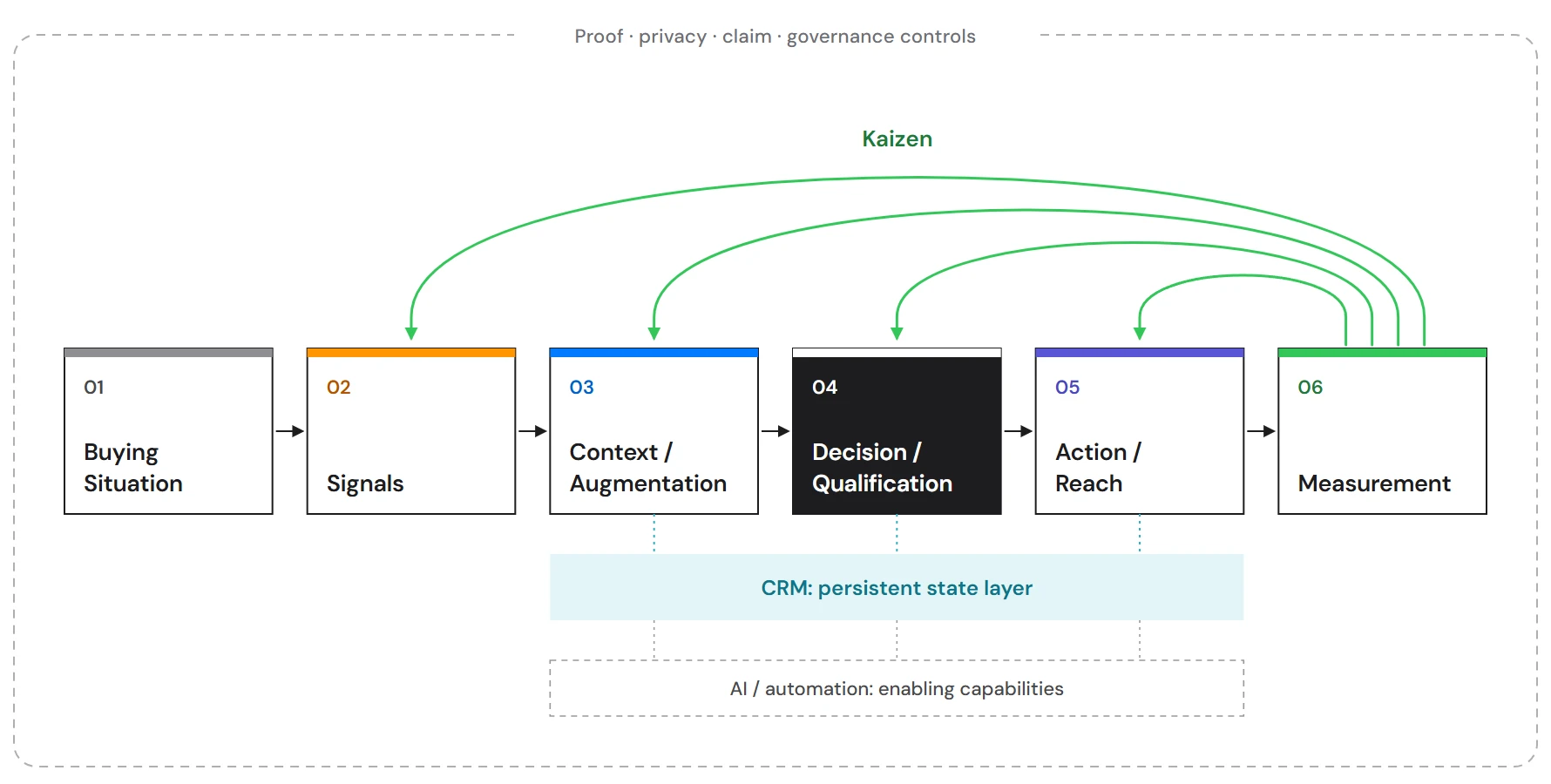
Kaizen loops from Measurement back to Signals, Context, Decision and Action.
Example architecture: UC-A
Signal-Led Outbound & ABM example:
Relevant hiring / company event → fit + role + CRM context → research / contextual outreach decision → response / opportunity learning → signal and message refinement
Do not label the account ‘in-market’ unless evidence beyond the signal supports that conclusion.
Example architecture: UC-B
CRM / RevOps Orchestration example:
Lifecycle / state event → CRM + hold reason + owner + stakeholder context → route / nurture / task decision → progression outcome → state/routing refinement
Build checklist
- Buying situation / GTM problem
- Signal source + observable event
- Recency / reliability rule
- ICP / fit rule
- Context required before action
- Qualification / state logic
- Human-review points
- Allowed next actions
- No-action condition
- Meaningful business events
- Learning / Kaizen rule
- Privacy / proof / claim controls